



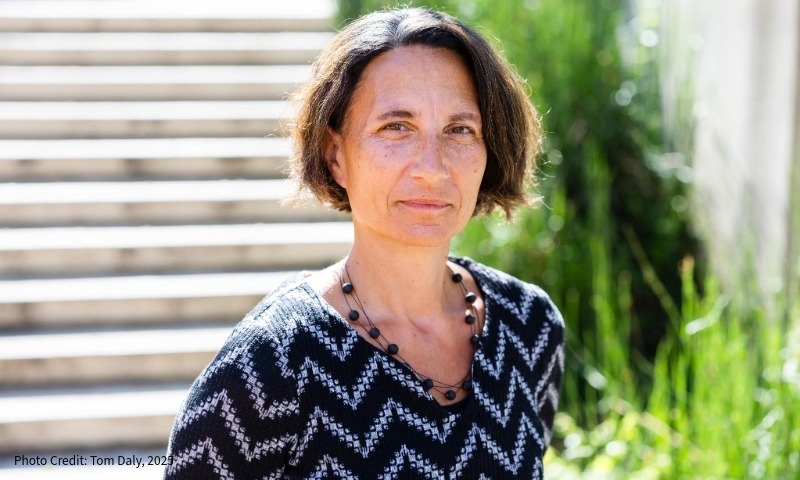
Mona El Khafif is an architect, urban designer, and dedicated educator who has taught at leading institutions in Austria, Germany, Canada, and the United States. She currently serves as an Associate Professor at the University of Virginia School of Architecture, where she directs the School’s Urban Design programs. El Khafif is the co-author of the award-winning URBANbuild: Local/Global (2009, with Ila Berman), the author of Staged Urbanism (German edition, 2009), and the co-editor of Next New York (2022, with Seth McDowell). Her work spans multiple scales and investigates temporal, typological, and collaborative strategies in urban design and architecture. These themes are being further developed in her forthcoming book, On Urban Prototyping.
Recently in an exclusive interview with Higher Education Digest, Mona shared insights into her passion for urban design, the importance of community engagement in urban planning projects, and her vision for the future of urban design. Mona also shared her favorite quotes, long-term career aspirations, and advice for students and young professionals interested in urban design and planning. The following excerpts are taken from the interview.
Hi Mona. What drives your passion for urban design, architecture, and planning?
First, thank you for reaching out to me. I very much appreciate this opportunity to be in conversation with you. My passion for urban design and architecture stems from a deep fascination with how the built environment shapes human experience and social interaction across multiples scales and temporalities. While I truly appreciate excellent design at the scale of the building (to the point that good architecture whether built or unbuilt fills me with happiness and excitement), I have also been drawn to projects that connect people, place, and ecology, where design has the power to create meaningful, equitable, and sustainable urban life. For me, urban design is not only about structures or landscapes only, but about understanding the complexity of urban environments as living systems and fostering interventions that enhance both human, non-human, and ecological resilience and well-being. This holistic perspective has guided both my practice and my teaching, as I seek to help students appreciate the profound social and environmental implications of every design decision. I also like to break through and work across disciplinary containers. Our constructed environment is shaped through many forces and interests. If we want to design within these complexities, we cannot build silos around our disciplines. I define urban design in this context more as a bridge between multiples disciplines that shape the city and therefore as a “field”.
I am an architect and simply love and admire what good design can bring to our daily lives. But I was also always interested in the collective and was eager to understand the larger systems.
What role do you think community engagement plays in successful urban planning projects?
When I was still teaching at the TU Vienna at the Institute for Urban Design and Landscape Architecture, Community Engagement became a required part of planning and design processes in Austria, and I assume also other European countries. The “Agenda 21”, adopted at the 1992 Rio Earth Summit, emphasized community engagement as a cornerstone of sustainable development. It called for local governments to create action plans, requiring broad public participation in decision-making. This framework positioned communities not as passive recipients but as active partners in shaping policies that balance environmental, social, and economic goals. By institutionalizing participation, Agenda 21 made community involvement a requirement rather than an option for achieving sustainability. Hence, since I am in academia community engagement had been a part of the implementation of urban design projects. However, even at this time, the implementation and development of these models were in the hand of spatial sociologists and planning practice. More recent paradigm shifts in the United States calling for social and environmental justice and the increased impact of climate change on our communities created an urgent call for community engagement across multiple disciplines and I would say that the field of Urban Design plays a key role.
When I launched our Master of Urban Design (MUD) at UVA I received a Center of Teaching Excellence Grant from the university to strengthen these aspects in the curriculum. The challenge though is not teaching “about” community engagement, but to prepare students for this practice in a curriculum that is project based. In other words, how can you integrate these aspects into the design process and how can you prepare students to sit in a community engagement workshop? In this context I published a paper entitled “In Action: Urban Design Pedagogy for Co-Production“. The paper introduces game strategies to integrate participation into the design process itself. It also introduces how educators can use role plays to prepare students for community engagement processes.
Maybe to summarize, I believe that community engagement is central to meaningful urban design. Projects succeed when they respond not only to technical, ecological, or aesthetic considerations but to the lived experiences and aspirations of the people who inhabit the spaces. Engagement allows designers to uncover nuanced insights that might otherwise be overlooked, and it fosters a sense of ownership and shared responsibility among community members. This ownership but also responsibility that comes with it is very important if we all want to call the neighborhoods we live in “our cities”. It is also true to observe that cities’ need everyone’s support to create and maintain public assets, social infrastructures, and open spaces. In this context colleagues and I developed a mobile app game called “We Are Martinsville (WAM)”. This gaming application was developed to encourage community engagement by prompting players to explore but also identify the city’s points of interest (POIs). It uses creative placemaking—leveraging Martinsville’s history, cultural assets, and landscape—to strengthen local identity through location-based gameplay, quizzes, event participation, photo submissions, and more. But most importantly it provides a digital infrastructure to engage with the place and to shape its identity through feedback and data submission. For me this is a powerful form of community engagement.
In my research and teaching, I emphasize participatory processes that value diverse voices, because urban design that ignores social context risks creating spaces that are underused, inequitable, or unsustainable.
How do you see the field of urban design evolving in the next 5-10 years?
I see urban design increasingly operating at the intersection of social equity, ecological resilience, and technological innovation. Which means, the field will need to contend with rapidly shifting demographics, environmental degradation and economic pressures as well as the application of new technologies that currently develop at light speed. I am here not only referring to what is described as “smart cities” but AI implementations in design pedagogy and practice.
In pedagogy, there is a growing emphasis on teaching students to think systemically and critically, integrating ecological, social, and technological frameworks rather than treating them separately. I anticipate that future urban designers will need to be both strategic thinkers, excellent designers, and empathetic collaborators, capable of negotiating complex social and environmental challenges while crafting spaces that are meaningful and adaptive.
When it comes to environmental challenges, I believe a large emphasis will be to design not only for growth but also for degrowth and repair. As climate change is showing its impacts through extreme weather events like heatwaves and flooding, we must design and regenerate cities that accommodate for cooling, absorb water, and offer habitat for humans but also non-humans. Just think about the efforts that Copenhagen is putting into place to retrofit the city with green and blue infrastructures that operate above and below ground to absorb water. Or Barcelona’s Superillas (superblocks) to improve Cerda’s original masterplan. These infrastructures need to be understood as multifunctional spaces, as places and habitats. I believe that we need new typologies that can accommodate for this and one chapter in my current book project “On Urban Prototyping” will be dedicated to these topics.
Meanwhile many urban territories will not be retrofitted. Either because there is not enough time or not enough funds or energy to do this. How can we design for a retreat that is considering environmental justice and environmental protection? What are the new models of co-production?
What has been your most career-defining moment that you are proud of?
Well, this is a difficult question, considering my age. When I graduated in the middle of the 1990s most of my peers applied for positions in Berlin, that at this time underwent a huge building boom due to the unification efforts and Berlin becoming the new capital of Germany. I was drawn to good housing models instead and decided to go into the opposite direction. I left Germany and moved to Vienna (Austria) a city that until today is known for its excellent public housing projects. I originally left for 1 or 2 years but never returned to Germany. This decision to move to Vienna probably impacted my professional career most, as it was the first departure followed by a series of other moves.
When I was an assistant professor at TU Vienna, we had a summer exchange program with Tulane University in New Orleans. My first engagement was in 2004, when colleagues and I organized a summer school in Vienna dedicated to rooftop urbanism. The following year, Hurricane Katrina struck New Orleans, devastating the city and our partner university. I had initially been invited to give a presentation on Urban Regeneration: Lessons from Vienna, but the circumstances shifted completely, and instead I was invited to join a new HUD-funded grant project as a visiting professor for URBANbuild. This program focused on four neighborhoods in the aftermath of Katrina, spanning studios from the city and regional scale down to the design-build of individual houses. Excited by the opportunity, I took a leave from my position in Vienna to join the effort.
Arriving in New Orleans, I quickly realized that the term urban design—so critical in the context of a flooded city—had very different connotations. Some students and colleagues equated it with urban planning, and when it comes to rebuilding, they focused primarily on the 1:1 scale of rebuilding, which was understandable given the massive housing losses. I faced two major challenges: first, adapting to the very different teaching culture in the U.S., and second, introducing students to a field they did not yet fully understand. At times I felt lost, but I persisted, and today I am proud that many of those first-year students came to see the value of urban design. Some pursued urban theses, some enrolled in post-professional urban degree programs, or are now working professionally on urban-scale projects. A turning point was taking students on a travel abroad program to the Netherlands, where they could directly study how cities live with water. Our work culminated in the 2008 publication URBANbuild: Local/Global, which reflects on how New Orleans can learn from other cities to adapt to and coexist with water. I extended my leave but in 2008 I was asked to return to Vienna. I decided to stay in the US for private and professional reasons, and I would say that this decision was one of the most important turning points in my career. I discovered that cities are the best classrooms places to learn from.
How do you prioritize your own well-being and self-care given the demands of your work?
As a designer, your work is never truly finished. I learned this early on as a student and later during my years in Vienna in professional practice. Even now in academia that hasn’t changed, but I’ve come to understand the importance of balance. I remind my students: try to give your best but also take care of yourself—because only then can you truly excel.
However, it took a long time to learn this myself. When I was writing my dissertation in Vienna, I worked with a coach who encouraged me to discover what recharged me. She used to say, “When you’re out running in the Prater, you’re working on your dissertation—recharging is part of the work.” She also helped me recognize my own biorhythms. Some people are more productive in the morning, others in the afternoon or evening. I discovered that I had very specific times when I could generate new content, and other times better suited for editing or graphic work. That discovery was empowering, and it’s something I encourage my students to explore for themselves.
Today, I still rely on nature to recharge—I go for long hikes, even when deadlines are pressing. I know that once I return, I am more productive and focused. In fact, my best ideas and strategies to approach a challenge are rarely coming when I am staring at the problem; they emerge when my mind is allowed to let go—often while I am running or walking outside.
Is there a particular person you are grateful for who helped get you to where you are?
I am deeply grateful to the many mentors and colleagues who have shaped my thinking and supported my development over the years. It begins with my doctoral advisers and mentors at TU Vienna, who gave me a strong foundation as a scholar and designer, and extends to the many collaborators I have been fortunate to work with since. Each of them has influenced the way I approach design, teaching, and leadership.
It is easy, however, to single out one person who has had an especially profound impact: Ila Berman, the former Associate Dean at Tulane University who was originally responsible for securing the URBANbuild grant and who invited me to join the project. Ila became a mentor to me at a pivotal moment in my career. She not only provided invaluable guidance but also created opportunities that allowed me to grow as a designer, researcher, and educator. Her vision for design as both a cultural and civic practice inspired me deeply, and her confidence in my work helped shape the trajectory of my career
What role has mentorship played in your career development, and how have you mentored others?
I believe mentorship is essential to becoming one’s fullest self. Mentors guide us in finding our path, help us build confidence, and equip us with the skills we need to excel in our professions. Sometimes mentors are inspiring because they show us what is possible. At the same time—and this may sound unconventional—I don’t think mentors are always those who are further along than we are. I have learned a great deal from my students, even when I was in the role of being their mentor. For this reason, I see mentorship as a reciprocal relationship, one that flows in both directions and that and strengthens the field by cultivating the next generation of thoughtful, socially conscious designers.
Overall, I would say, that mentorship has been foundational in my career, providing guidance, perspective, and opportunities for growth. Equally important has been the responsibility to mentor others, particularly emerging designers and researchers.
What is your favorite quote?
I think over the last 20 years I tried to follow:
“Ever tried. Ever failed. No matter. Try again. Fail again. Fail better.” Worstward Ho (1983) Samuel Beckett.
What are your long-term career aspirations, and how do you see yourself evolving as a leader over the next five years?
This is an interesting question. I consider myself both strategic and tactical, which means I like to pursue opportunities where they arise. Yet, looking back, I can see a clear consistency in my career decisions. Since the beginning of my academic career, I have focused on contributing to urban design education within architecture schools. In Europe, urban design is a core component of the curriculum, and upon moving to the U.S., I have consistently sought to strengthen urban design education at every institution I have been part of.
I founded or co-directed two labs: URBANlab at California College of the Arts (2008-2013) and the DATAlab at the University of Waterloo School of Architecture (2013-2016) together with Maya Przybylski. At UVA, I established two urban design programs—the master’s in urban design (MUD) and the Urban Design Certificate (UDC) and several years ago, together with colleagues from urban design programs across the U.S., I co-founded the Urban Design Academic Council. Today, I serve on its steering committee, and alongside my colleague Nico Larco from the University of Oregon, I am particularly interested in developing urban design education for undergraduates, continuing education, and networked pedagogy that spans multiple institutions through summer schools and virtual modules. I can imagine continuing this work at UVA or another institution, where I can lead a program or chair an institute dedicated to advancing urban design education.
However, last year, I was a visiting professor at the University of Toronto’s School of Cities. The School of Cities does not offer a standard curriculum; rather, it serves as a world-leading center for innovative, interdisciplinary urban research and engagement. Its goal is to bring together diverse communities—including scholars, practitioners, and residents—to collaboratively address complex urban challenges and design creative solutions that enable cities and their citizens to thrive. I found this approach very inspiring, and I can envision a light shift in my career toward applied academic practice—steering somewhat away from traditional teaching and more toward initiatives like the School of Cities or others that bridge research, practice, and city partnerships.
What advice would you give to students and young professionals interested in urban design and planning?
My advice to students and young professionals entering urban design is to cultivate curiosity, resilience, and a deep understanding that design should always contribute positively to the world. Urban design truly matters—it shapes how we live, interact, and experience our cities. More architects, planners, and landscape architects should enter this field, as their expertise is urgently needed in the face of complex social, environmental, and infrastructural challenges. The years ahead will be marked by uncertainty and rapid change, making thoughtful, socially responsible, and well-informed design essential for creating cities that are livable, equitable, and resilient.
To meet these challenges, stay open to new ideas, diverse perspectives, and the voices of the communities you serve while committing to what you can contribute to the process. Cultivate resilience to embrace uncertainty, learn from setbacks, and continue moving forward. Let sustainability, equity, and care for the living world guide your work—not as add-ons, but as foundations. Remember that cities are collective projects: the most meaningful outcomes emerge from collaboration, listening, and co-creating shared visions.
Finally, commit to lifelong learning and recognize that your work matters. In shaping the future, you also take on the role of teaching and inspiring others. Together, we share the responsibility of designing a better world for tomorrow.