



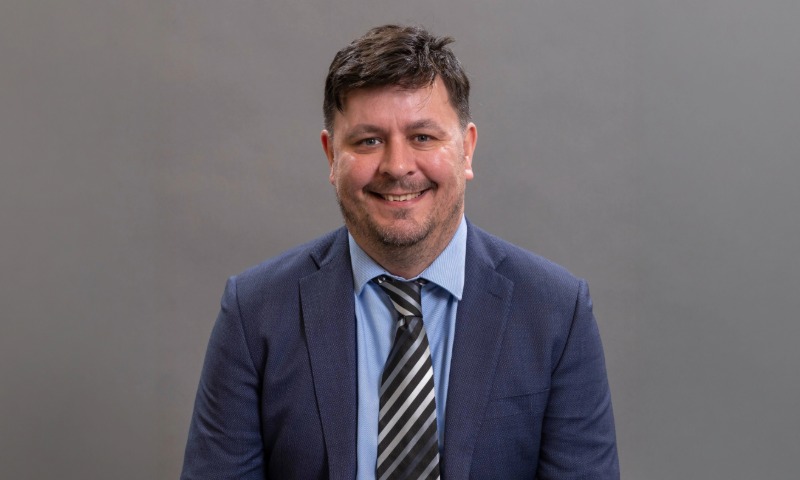
Dan Parsons is a geoscientist and research leader whose work examines how sediment transport and fluid dynamics shape rivers, coasts, and marine environments in a changing climate. He combines fieldwork, laboratory experimentation, and advanced modelling to understand environmental hazards and support climate resilience. As Pro Vice-Chancellor for Research and Innovation at Loughborough University, he champions interdisciplinary collaboration, equitable research cultures, and impactful partnerships with communities, industry, and policymakers. Dan has authored over 200 publications, led major international projects, and is committed to mentoring the next generation of researchers and enabling science that delivers real-world benefit.
Recently, in an exclusive interview with Higher Education Digest, Dan shared insights into his transformative research journey, interdisciplinary collaborations, and vision for shaping the future of geosciences. He also shared his favorite non-academic book, future plans, pearls of wisdom, and much more. The following excerpts are taken from the interview.
Hi Dan. Please tell us about your background and areas of interest.
I’m a geoscientist – well I guess a process sedimentologist and fluid dynamicist, working at the interface of geology, geography, engineering, and environmental change. I would summarise that I played with sand, mud and water as a kid and never really grew up. My research focuses on how sediment moves through rivers, coasts, estuaries, and deep marine systems, and how these processes influence hazards, ecosystems, and human societies. I’ve spent my career combining fieldwork, laboratory experiments, and computer modelling to understand earth’s surface and what controls the dynamics of these surfaces. Its incredible to think that the thin veneer of earth’s surface, a few hundred meters down and a few hundred meters up is where all known life in the Universe exists and is supported. I’m also deeply involved, now as PVC Research and Innovation at Loughborough – as well as previously as Director of the Energy and Environment Institute at the University of Hull, in research and innovation leadership and enabling inclusive, impactful research cultures.
What do you love the most about your current role?
I love enabling brilliant researchers to thrive. As Pro Vice-Chancellor for Research and Innovation at Loughborough, I get to not only still advance some of my own programme of research, but also help shape strategy, support interdisciplinary collaborations, and create environments where ideas and people can flourish. One moment I can be talking to colleagues who are pioneering the phonics equivlent for mathmatiucs in how youg children learn maths and in the next moment be standing next to the CTO at Rolls-Royce as the lastest nozzle for a hydrogen jet engine is tested at our National Centre for Combusion and Areothermal Technoligy. This lets me both stay connected to research that genuinely excites me, particularly work that tackles climate hazards and benefits communities – but also see others advance their research and have pride that I have played a small and minor role in helping that awesome thing they just went and did!
What do you believe are the most critical global challenges that geoscientists can help address?
Geoscientists are absolutely central to addressing climate change, biodiversity loss, water scarcity, natural hazards, and sustainable resource management. We understand the physical systems underpinning these challenges, and we’re uniquely positioned to co-develop solutions with communities, engineers, and policymakers. Our science an d engineering is fundamental to resilience, adaptation, and environmental justice. However, we must also work with social scientists and others to ensure that we advance “solutions” or adaptations that genuinely help societies and communities around the world.
How do you see your field evolving in the next decade, and what role do you hope to play?
We’re entering a data-rich era, where high-resolution sensing, AI, and complex systems modelling will transform how we understand environmental processes. At the same time, co-produced, community-engaged science is becoming essential. I hope to help lead a new generation of interdisciplinary, socially responsive research that blends physical science with lived experience to support equitable climate adaptation and that we use data and AI in a way that advances out capabilities in a socially just way.
What are some common misconceptions about geosciences that you’d like to dispel?
That geoscience is only about rocks, or oil and gas – or that it belongs in the past done by hairy blokes with socks and sandals. In reality, it’s one of the most forward-looking disciplines we have. Geoscientists work on everything from renewable energy to climate modelling, planetary science, and sustainable infrastructure. It’s a field deeply connected to society and our shared future. I think we must do a better job of selling geosciences and what challenges our area addresses.
What role do you think mentorship plays in the development of early-career researchers?
Mentorship is absolutely critical and the most important element of anyone’s career in my view. It shapes confidence, opens doors, and helps people navigate the often-opaque structures of academia or industry alike. The best mentorship is reciprocal in my view – it’s about listening, empowering, and creating opportunities. Mentors that get you to reflect without you realising it are the best (well for me at least). I’ve benefitted enormously from mentors in my career – generous people who gave me a chance or lent me their ear – and I really do see it as a core responsibility to pay that forward and build inclusive, supportive research cultures.
Can you share a book, podcast, or resource that has inspired you recently?
I’ve been inspired recently by The Good Ancestor by Roman Krznaric. It’s a powerful reminder of long-term thinking, responsibility, and the intergenerational dimensions of the climate crisis—ideas that resonate strongly with environmental research and leadership.
What is your favorite non-academic book and why?
Lately I’ve been enjoying Wankernomics, partly because it keeps me honest. In leadership I think it is all too easy to drift into sounding like a parody the Ricky Gervais office manager character. I’ll catch myself saying “lets zoom in on that” or “moving forward” or “circle back” …..in order to sound more managerial I guess….what baloney! Its just words that are not needed. The book is a sharp, funny reminder of how not to take yourself too seriously, stay grounded, and keep the work focused and affective on real people and real purpose.
Where do you see yourself in the next 5 years?
I see myself continuing to champion research and innovation that makes a difference and strengthening interdisciplinary partnerships, supporting emerging talent at Loughborough. I want to help shape a research ecosystem that is equitable, outward-looking, and globally connected. I am someone who likes to really make a difference and I don’t think you can do that in just a few years somewhere. So, unless CalTech come calling I see myself completing a full term as PVC here at Loughborough before thinking about the next move. One Day I think I would like the CEO of UKRI role or something like that, really shaping the whole research and innovation landscape across the country – but I think that is a good 10 years away yet.
What advice would you give to students or early-career professionals looking to enter the field of geosciences?
Stay curious, embrace interdisciplinarity, and keep people and purpose at the centre of your work. Geoscience thrives when we connect physical processes with societal needs. Don’t be afraid to carve your own path, seek mentors who genuinely listen, and remember that the world needs your ideas more than ever.