

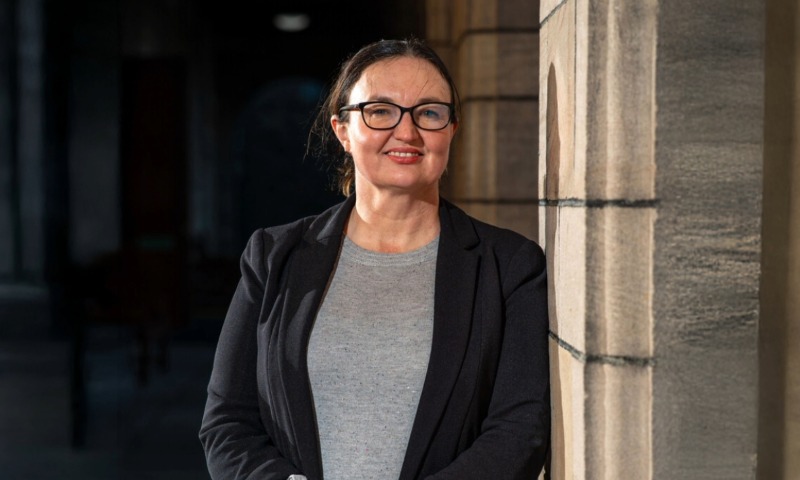
Professor Jo-Anne Murray is Vice-Principal Education at the University of Aberdeen, responsible where for all aspects of education and the student experience. Prior to joining Aberdeen, Jo-Anne was Pro-Vice Chancellor, Digital Transformation at the University of Leeds. Previously, Jo-Anne was a Managing Director at Higher Ed Partners and Assistant Vice-Principal Digital Education, at the University of Glasgow. She has also held senior roles at the University of Edinburgh leading on digital education. Jo-Anne is Professor of Educational Innovation and a Principal Fellow of the Higher Education Academy and has led many novel and innovative approaches to education.
Recently, in an exclusive interview with Higher Education Digest, Prof Murray shared her professional trajectory, insights into the future of education and the importance of adapting to technological changes. She also shared her personal hobbies and interests, future plans, words of wisdom, and much more. The following excerpts are taken from the interview.
Hi Prof Murray. Can you tell me about your career journey and how you got to where you are today?
I had a non traditional path to University. I left school at 16 to care for my mother who was ill and then I went to college to study and HNC, then HD and went on to University from there. After my degree I did a masters and moved on to a PhD as I loved research. I was fortunate to begin my first lectureship in 2002 at the University of Wales, Aberystwyth. In 2004, I moved to a job at the University of Edinburgh (UoE) as a coordinator for a new maters programme and shorty after became the programme director. This was an on campus programme and it became apparent that there was a lot of interest in studying part-time, but many were not local. At the same time (2005) there was talk across the University of online learning and that gave me the idea of converting the maters to online. From there one of the first online programmes at the University of Edinburgh was created and I moved into Director of Taught Postgraduate programmes and Head of elearning in the School of Veterinary Medicine. This led to a Deputy Dean role in the College of Medicine and Veterinary Medicine at UoE and then to Associate Dean, Digital Education in the College of Medicine, Veterinary and Life Sciences at the University of Glasgow where I then progressed to Assistant Vice-Principal, Digital Education. After this, I spent a few years in the private sector working for a global online programmes management company and gained invaluable experience in supporting Universities with digital transformation of education, which led to my next role as Pro-Vice Chancellor, Digital Transformation at the University of Leeds. A return to Scotland for my current role as Vice-Principal Education at the University of Aberdeen two years ago has enabled me to continue to transform education and contribute to helping our students achieve their goals and ambitions.
What do you think are some of the most significant trends or changes in the world of education, and how do you think educators can adapt?
I think the world has changed significantly, particularly in relation to technology. Gen AI is everywhere and not going away. As educators we need to teach AI literacy and redesign our assessments. There is also a move towards, modular, lifelong learning and micro credentials. As educators we need to design stand alone stackable learning aligned with real-world skills and offering flexibility. There is more demand for skills development and as such we need to move away from delivering content to facilitating learning. Inclusive learning with a focus on wellbeing is also required, adopting a universal design for learning approach.
How do you see the future of online learning evolving, and what role do you think institutions should play in shaping this future?
The future of online learning is, stackable, skills-focused pathways supported by AI to provide personalised learning. AI will support with planning, practice and feedback, while human educators focus more on dialogue, coaching and complex, practice-rich work (including simulations, placements and projects). The role of Institutions in shaping this should be around ensuring quality, access and inclusion alongside investing in staff capability. They also need clear strategies for micro-credentials, data and AI governance, and partnerships with employers and other providers, while protecting the high-touch, community-building aspects of education that technology can support but not replace.
What do you think are some of the most important qualities or skills for educators to have, and why?
I would say the most important quality is caring for students and being prepared to listen to what the learner needs.
Have you had any mentors or role models who have significantly impacted your career, and what did you learn from them?
I have not had any mentors as such, but I have had many people I have admired. Those that have been prepared to think differently and create an environment of being creative.
Are there any particular books, articles, or resources that have significantly influenced your thinking or approach?
I spent a lot of time listening to podcasts from all different people, sectors and topics. I particularly enjoy the Diary of a CEO.
What is your favorite quote?
“Progress over perfection” is my favorite quote – we get paralysed waiting for things to be perfect when we need to be more willing to try new things and accept that not everything will work and that failure is ok, in fact it is important for our learning.
What are some of your passions outside of work? What do you like to do in your time off?
I love to ride horses and regularly compete in dressage – it is a great sport and working outside with the horses is great for physical and mental wellbeing.
What is your biggest goal? Where do you see yourself in 5 years from now?
My biggest goal is to be able to help others achieve this goals, particularly those for who life has been challenging for a variety of reasons, which is why I am passionate about inclusive education.
What advice would you give to early-career academics or professionals aspiring to leadership roles in higher education?
My advice is to be yourself and not to let anyone tell you that you are not capable your achieving your goals. Be brave in trying new things and do not get disheartened when things don’t work or go to plan, it is all part of your learning and journey.