


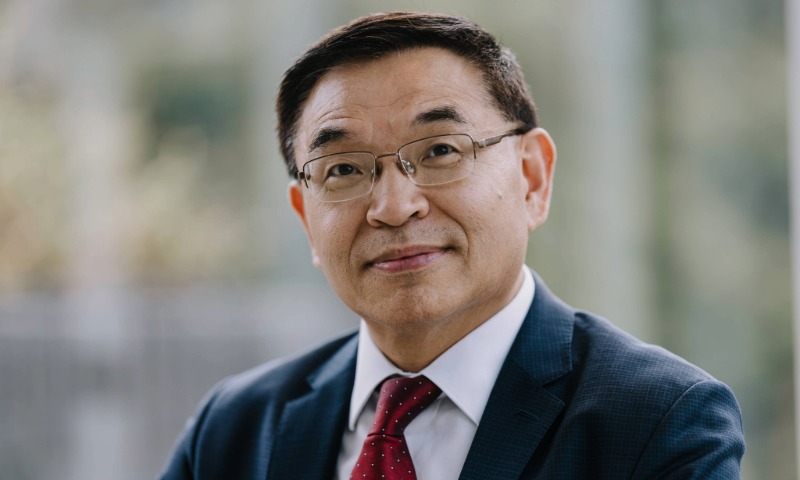
Professor G.Q. Max Lu AO is a globally recognised chemical engineer and advanced materials scientist who became the sixth Vice-Chancellor and President of the University of Wollongong in May 2025. He brings more than 35 years of academic leadership, research excellence and industry engagement to the role. Before UOW, he was Vice-Chancellor of the University of Surrey and held senior leadership roles at the University of Queensland. An internationally renowned researcher, he has published more than 600 papers, holds 25 patents, and was appointed an Officer of the Order of Australia in 2017 for distinguished service to education and international research.
Recently, in an exclusive interview with Higher Education Digest, Max shared insights into how curiosity, service, and disciplined attention have shaped his journey from rural China to leading one of Australia’s most globally connected universities. To meet the industry’s outpacing demand for talent in advanced materials and clean tech, he called for greater investment in PhD research linked to business needs and broader doctoral training with industry-linked PhDs, internships, co-designed projects, and entrepreneurial skills that bridge academia and workforce demand. As students enter as AI natives, he believes curricula must embed AI literacy alongside critical thinking, ethics, systems thinking, and communication so graduates can lead technology responsibly, not just use it. To aspiring leaders and scientists, his advice is to stay focused, stay humble, and listen carefully before acting, because progress comes from collaboration, persistence, and keeping purpose and people at the center. The following excerpts are taken from the interview.
Hi Max. Your academic journey spans over 38 years across chemical engineering and nanotechnology, with more than 600 publications and 111,000+ citations. How did your early research interests evolve into the globally impactful work you lead today?
My early curiosity was always about how things work and how they can be improved. Growing up in rural China, I saw firsthand how education and opportunity can change a life and that stayed with me when I came to Australia to study chemical engineering. Over time, my research moved from chemical engineering into nanotechnology and advanced materials for energy and environmental applications, but the core motivation never changed: to use science and engineering to solve real problems and improve people’s lives. That is also why I have always been interested not just in discovery, but in translation – turning knowledge into impact for society.
What do you love the most about your current role?
What I love most is the people – students, staff, alumni and the wider community. Being Vice-Chancellor is a privilege because it allows me to bring people together around a shared purpose and to help create conditions in which others can thrive. I also enjoy the daily learning that comes from listening carefully, because universities are full of insight in every corner, from labs to classrooms to community conversations. It is deeply rewarding to be part of shaping a university that changes lives and contributes to the future of the region and the country.
Universities are under pressure to deliver both basic research and commercial outcomes. How should research universities rebalance discovery science and industry translation in the next five years?
We should not think of discovery and translation as competing priorities – they are part of the same pipeline of value creation. Universities must continue to support curiosity-driven research, because that is where many breakthroughs begin, but we also need stronger pathways that help promising ideas move into application, through entrepreneurship and commercialisation. That means deeper partnerships with industry and government, more support across the research lifecycle, and a clearer focus on national priorities such as clean energy, advanced materials, AI and health. If we get that balance right, universities can remain engines of knowledge while also powering productivity and prosperity.
Industry demand for talent in advanced materials and clean tech is outpacing supply. How should universities evolve doctoral training to meet industry’s needs?
First and foremost, we need to recognise the importance of doctoral-level skills in innovation-driven economic growth and productivity uplifting. There should be more investment in PhD research, particularly linked with business and industrial needs. Doctoral training also needs to become broader, more connected, and more outward-facing. We should absolutely maintain rigorous research standards, but we also need to give HDR students more exposure to industry-relevant problems, collaborative projects, translational pathways, and entrepreneurial skills. Industry-linked PhDs, internships and co-designed research projects can help bridge the gap between academic training and workforce demand. At UOW, this sits very naturally alongside our focus on research that strengthens workforce capability and delivers practical impact.
Higher education itself is being disrupted by AI, micro-credentials, and global online platforms. What part of the traditional university model must adapt fastest to stay relevant by 2030?
The fastest adaptation must be in how universities design and deliver learning. Students increasingly expect flexible, blended and lifelong learning pathways, not just a one-time degree. That means universities need to embrace micro-credentials, online and offshore delivery, work-integrated learning and technology-enhanced teaching – while still protecting academic quality, human connection and belonging. The model must become more responsive, more personalised and more connected to the real world. One of the key challenges we must meet is to reimagine how we assess learning, shifting from a product of learning to a process and critical thinking.
Students are entering universities as AI natives. How should curricula in science and engineering evolve so graduates can lead, not just use, AI tools?
AI literacy should be embedded across the curriculum, but leadership requires more than technical competence. Our graduates need the ability to question outputs, understand limitations, work ethically and apply AI in context. Science and engineering education should combine AI with critical thinking, problem-solving, systems thinking and communication, so graduates can shape technology responsibly rather than simply consume it. The goal is to produce people who can lead innovation in a world where AI is becoming part of every profession.
Great leaders are shaped by ideas outside their field. What book outside science or engineering has stayed with you, and what idea from it still guides your decisions?
Yes, definitely! For example. I really enjoyed Daniel Goleman’s Focus –the Hidden Driver of Excellence, and Steve Sample’s Contrarian’s Guide to Leadership. From Focus, I learned that excellence rests on the disciplined deployment of three kinds of attention: inner (self-awareness, emotional regulation), other (empathy, reading people and relationships), and outer (systems thinking, grasping the wider context). In an era of many distractions, attention is the scarce resource that compounds and it can be trained.
Whereas Sample’s Leadership lessons are so powerful in that effective leaders deliberately think and act differently from the herd. They think grey, think free, read the “supertexts” rather than chase the news cycle. They work only on what truly matters and require them to make and delegate most decisions to others closer to the problem.
Both books are, at root, about what a leader chooses not to attend to. Goleman frames it as cognitive architecture; Sample as political and temperamental discipline. Read together, they argue the scarce executive asset is curated attention and the discipline to protect it from the urgent, the loud, and the consensus.
Innovation requires curiosity beyond the workplace. What’s a hobby or interest people would be surprised to learn you’re passionate about?
People may be surprised that I really value simple things like walking and spending time in quiet reflection, especially by the ocean or while walking across campus. Those moments help me think clearly and stay grounded. I also enjoy the everyday conversations that come from being out and about in the community, because they keep me connected to what matters most. In that sense, curiosity is not just something I bring to science – it is part of how I live and lead.
What is your biggest goal? Where do you see yourself in 5 years from now?
My biggest goal is to help UOW realise its vision of empowering student success, delivering world-leading teaching and research, and driving local and global impact. In five years, I hope to see UOW stronger, more resilient and more connected – with even greater global recognition for the quality of its education, research and partnerships. I would also like to see us making a measurable contribution to regional prosperity, national productivity and global challenge-solving. Personally, I want to know that I have helped build something lasting with our people and our communities.
If you could only pass on one piece of advice to an aspiring university leader or scientist, what would it be?
Stay focused, stay humble, and listen carefully before you act. The best leaders are those who can combine ambition with service, and expertise with empathy. In science and higher education, progress rarely comes from one person alone – it comes from collaboration, persistence and a willingness to keep learning. If you keep your focus on purpose and people, the rest can follow.