



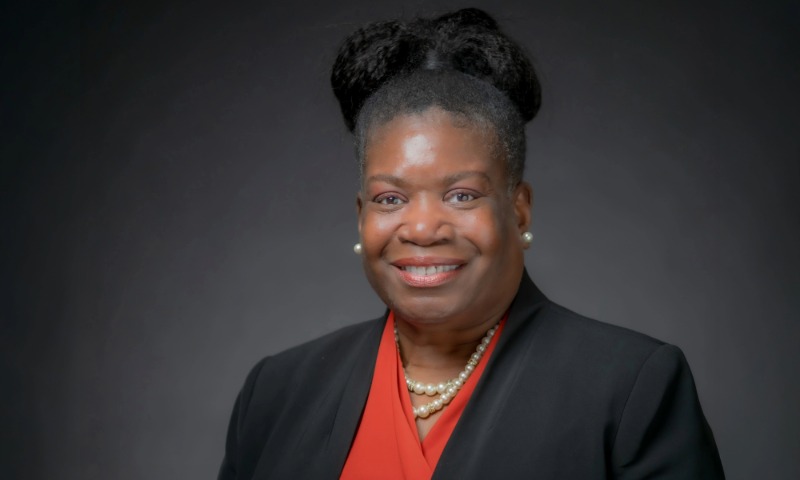
Dr. Theodorea Regina Berry serves as Dean of Bloomfield College of Montclair State University and Professor of Curriculum Studies, Department of Education Foundations, College of Education and Engaged Learning. Dr. Berry’s research appears as journal articles, book chapters and books including Latinx Curriculum Theorizing (Lexington Books, 2019), From Oppression to Grace: Women of Color and their Dilemmas Within the Academy (Stylus Publishing, 2006) and States of Grace: Counterstories of a Black Woman in the Academy (Peter Lang, 2018). Dr. Berry serves as the 2023-2026 Vice President for Division B (Curriculum) of the American Educational Research Association.
Recently, in an exclusive interview with Higher Education Digest, Dr. Berry shared insights into her journey in curriculum studies, sparked by her undergraduate studies and influenced by scholars like John Dewey and bell hooks. She highlighted the value of women of color in academia and advocates for inclusive environments. She also shared her favorite quote, personal hobbies and interests, future plans, and much more. The following excerpts are taken from the interview.
Hi Dr. Berry. As a renowned educator and researcher, you’ve made significant contributions to the field of curriculum studies – what sparked your interest in this area, and how did your journey begin?
My interest in the field began as an undergraduate student enrolled in a communication theory course that was required for my major. The course focused on the use of dialogue and discourse (from Socrates and Plato) as sources of knowledge and the ways in which knowledge is disseminated, constructed, and produced. As a student enrolled in a masters degree program, I was introduced to the work of John Dewey and his perspectives on lived experience as knowledge as well as the scholarship of bell hooks and her conceptualizations of engaged pedagogy and the ways in which culture influences knowledge construction.
What do you love the most about your current role?
I love working with faculty on ways to connect curriculum to lived experiences and I love connecting faculty and community stakeholders to curriculum in relation to community engagement. I thoroughly enjoy serving as a voice of the university to the community about the value of higher education.
As the education landscape continues to evolve, what emerging trend excites you most, and why?
The emerging trend that excites me most is the notion of guiding college and university students to be future-ready. Future readiness is connected to the idea of social futures and what communities will look like one generation forward and what these communities will need. I am excited about the ways in which higher education can significantly engage in the development of the future-ready citizen.
Your work focuses on issues of race, ethnicity, and education – what drives your passion for addressing these critical topics?
My passion for addressing these critical topics rests not only in my own lived experiences but also in the lived experiences of my parents and my ancestors. My parents placed a high value on the acquisition of a solid education and attaining maximum education was a goal they had for me and my siblings. I learned at an early age that access to education was not the same for everyone in this country and that, for many years, was predicated on race and ethnicity. My works strives to value the lived experiences of people of color while, at the same time, offer lessons for errors not to be repeated.
You’ve written about the experiences of women of color in academia – what’s the significance of this work, and how can we create more inclusive environments?
Historically, higher education was not available to women and women of color. This country has made great strides from that moment to this moment in history. My work strives to highlight the value of the experiences of women of color in academia and the lessons we have learned from creating spaces for productivity in the academy. I also believe there is always something more to learn. We can create more inclusive environments by, first, examining the ways academia has benefitted from the productivity and innovations of women of color. Second, by making more spaces for such voices to be included in decision-making. Finally, mentorship from seasoned administrators and scholars, regardless of the mentor’s race or gender, should be part of the academic landscape — for everyone.
As a professor and researcher, you’ve mentored many students and early-career scholars – what’s your approach to mentorship, and how can others pay it forward?
My approach to mentorship starts with a conversation with the mentee about their goals and aspirations. I use a scaffolding approach that starts with a small or simple task. Each task or project should build upon foundational knowledge and skills and develop new knowledge and/or skills. Paying it forward can be something as simple as having a conversation with a student or early-career scholar, reading a manuscript for review before submitting for publication, doing a mock interview for a student who is preparing to interview for jobs, or writing a letter of recommendation. Each of these things (or other things) can serve as another layer in the scaffold that helps get the mentee along the path toward their next destination.
Are there any particular books, articles, or resources that have significantly influenced your thinking or approach?
The scholarship of bell hooks has greatly influenced my thinking and I have read almost every book she has written. I am also drawn to the books written by former president Jimmy Carter.
What is your favorite quote?
“Education is not preparation for life; education is life itself.” John Dewey
What are some of your passions outside of work? What do you like to do in your time off?
When I take time off, I travel internationally. Being in other places and spending time with other people is a reminder that human beings are, essentially, the same all over the world. I also enjoy reading, cooking foods from other countries, and singing.
What is your biggest goal? Where do you see yourself in 5 years from now?
My biggest goal is to play a significant role in elevating access to higher education, globally. I hope to be a leading voice in the value of higher education and the multi-dimensional ways higher education can continue to support communities and society. Five years from now, I hope to be a part of a coalition of academic researchers, scholars, administrators, and stakeholders who are connected globally to see this vision into fruition.