



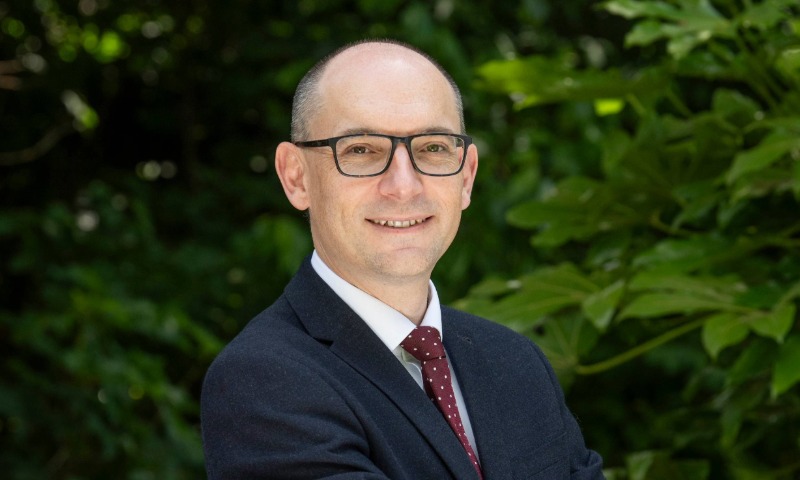
Dan Wood is Chief People Officer at UWE Bristol, leading people, culture, and transformation for 4,000 staff and 40,000 students. A principled, people-first leader, he aligns strategy, systems, and culture to build trust and make a positive impact at scale. Over two decades across higher education, healthcare, policing, and the voluntary sector, he has led large-scale change, advanced equity, and strengthened civic partnerships locally, nationally, and internationally. He is a Fellow of the CIPD, RSA, CMI, the Institute of Leadership, and the Society of Leadership Fellows at Windsor Castle.
Recently, in an exclusive interview with Higher Education Digest, Dan shared insights into his background, expertise, and leadership approach. Dan discussed his role in aligning strategy, systems, and culture to build trust and drive positive impact. He emphasised the importance of civic leadership, staying current with the latest developments, and the need for leaders to work on themselves and their relationships to build resilience. Dan also highlighted his values-driven approach to leadership and shared advice for aspiring leaders, including prioritising usefulness over optics and showing moral courage. The following excerpts are taken from the interview.
Please tell us about your background and areas of expertise.
I’ve spent twenty-odd years working out how institutions can serve people better. I came up through public service: youth leadership first, then teaching, healthcare, policing, higher education, and the voluntary sector. Now I’m Chief People Officer at UWE Bristol, where I combine strategy, systems, and culture together, so the university works for people day to day. My work runs from organisational design and leadership standards to equity and belonging, people services and large-scale transformation. Service is my bloodstream. I stay engaged in the civic space as well, because institutions behave better when they’re porous to the communities they serve.
What do you love most about your current role?
Being close to what matters. Universities change life chances and local economies; they’re escalators of social mobility. I enjoy turning good intentions into working practice: a process that stops wasting time, a leadership programme that shifts behaviour, data that nudges us towards fairer decisions. That everyday competence, crafted by colleagues, beats any headline. And we do get our moments: graduations that fizz with pride, research that lands with impact in the world, partnerships that make a difference on real-world challenges.
What are the most significant challenges facing leaders today?
We’re leading through a tangle of challenges; tight budgets, tech upheaval, changing demographics, fraying trust, and growing division. It’s tempting to act like we’ve got all the answers, or to keep things vague and distant. But that’s not what’s needed.
The real job is to stay true to our principles while staying flexible in how we get things done. Brittle things break; resilient ones bend and bounce back. That means leaders need to do the inner work — and build strong relationships — so teams can stay steady without losing honesty or hope.
We don’t need a fixed route. We need a compass that helps us find our way, even when the path forward changes.
What role does civic leadership play in shaping organisational culture and values?
A decisive one. Civic leadership is where values meet consequences. Chair a youth body, steward a community foundation, work with the police on inclusion and you will encounter the lived reality policy in practice. Culture becomes a pattern of choices visible to the public. Universities are anchor institutions; we should think outside-in and act for public value. Done properly, civic leadership makes a university more porous, more trustworthy, more useful. It turns values into habits and habits into reputation. Staff feel proud, students feel they belong, and partners experience the institution as a shared civic space for the common good.
How do you stay current with the latest developments in your field?
By staying curious. I read across borders, swap ideas with colleagues, students and partners, and run small, low-risk experiments to see what works. “New” isn’t automatically best; I treat trends as hypotheses, who benefits, what’s assumed, what’s missing? Our UWE values—enterprising, ambitious, collaborative, innovative and inclusive—push me to learn in public: pause, reflect, admit bias, share credit, change my mind when evidence evolves. The aim is usefulness, or turning good insight, wherever it comes from, into fairer, more human practice for public value. I share early and think out loud, invite critique, ask awkward questions, and let the world mark my homework, which can be bracing, humbling, and efficient!
A mentor or role model who has shaped you, and the advice that stuck?
Two leaders changed my trajectory. One gave me my first executive role and, more importantly, his trust. He taught me that courage and compassion travel best as a pair, and that supporting people publicly whilst coaching them privately creates loyalty that moves mountains. The other pushed me to think and act boldly, with big ideas, local impact, and to measure leadership by how many others you help to rise. From both, I’ve learnt the long view: set a clear direction, hold your nerve, and stay the course. Adjust tactics without losing purpose. The abiding advice is simple: decide bravely, listen humbly, let credit travel, and see good work through.
Your favourite quote, and why?
“For us, there is only the trying. The rest is not our business.” That’s from East Coker by T.S. Eliot. Written during the Second World War, it’s a humbling, freeing reminder that leadership is integrity in the attempt. It’s a gentle antidote to ego and anxiety. We control effort, not outcome. Show up, do the work, learn out loud, and let results follow the craft. It’s got me through more than a few difficult decisions.
A book or resource that inspires you?
I’m drawn to works that help us see afresh. Brené Brown’s Atlas of the Heart clarifies the emotional landscape that so often sits beneath people’s challenges. Gareth Morgan’s Images of Organization shows how every metaphor illuminates and distorts, an argument for plural ways of seeing. Burrell and Morgan’s Sociological Paradigms and Organisational Analysis reveal the worldviews and assumptions behind our theories and methods. And Eckhart Tolle’s The Power of Now offers a radically simple discipline of presence. I love writing that helps us notice differently; ourselves, others, and the systems we build.
Long-term career aspirations: how do you see your leadership evolving over five years?
I want to deepen my impact on leading institutions that serve the public good. I’m motivated by learning, human rights, justice, good governance, healthcare, community cohesion, and internationalism, and by the conviction that universities can be engines of trust in a defining era for humankind. I aim to lead at the system level whilst keeping a grounded understanding of the reality of frontline work: delivering people and culture changes that matter, convening across sectors where progress actually lives, and staying close enough to operations to stay grounded. My hope is straightforward: to pair practical ethics with an ambitious collective purpose and leave the place better than I found it. I want to continue to grow and develop in a direction that enables me to maximise positive impact and public benefit.
What advice would you give aspiring leaders on a similar path?
Choose usefulness over optics. Be an integrator across disciplines. Show your workings, invite dissent, and change your mind when better evidence arrives. Set standards bravely; help people meet them kindly. Culture change is a thousand acts of congruence, repeated until normal. Protect compounding habits, including learning, moral courage, compassion, and respect. Know what matters, stay flexible, seize chances that let your values do the work. Hire for difference; surround yourself with doers, coaches, and challengers. Start small, deliver visibly, let trust snowball. Learn how to get things done and then help others do the same, and get out of their way.