


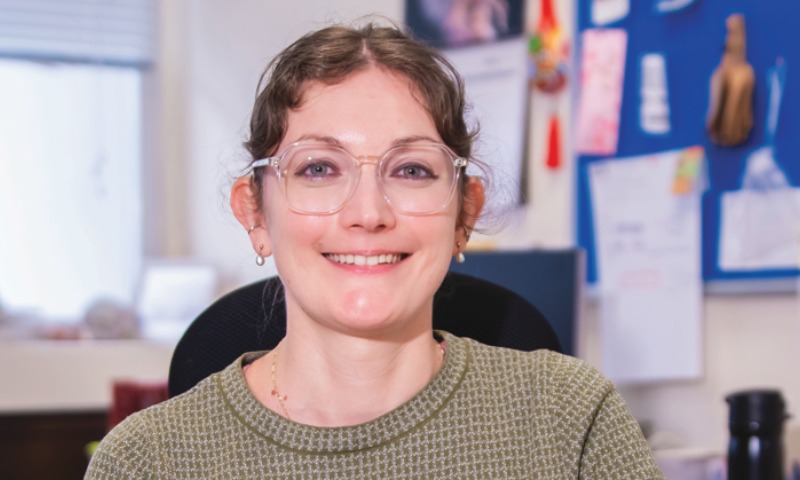
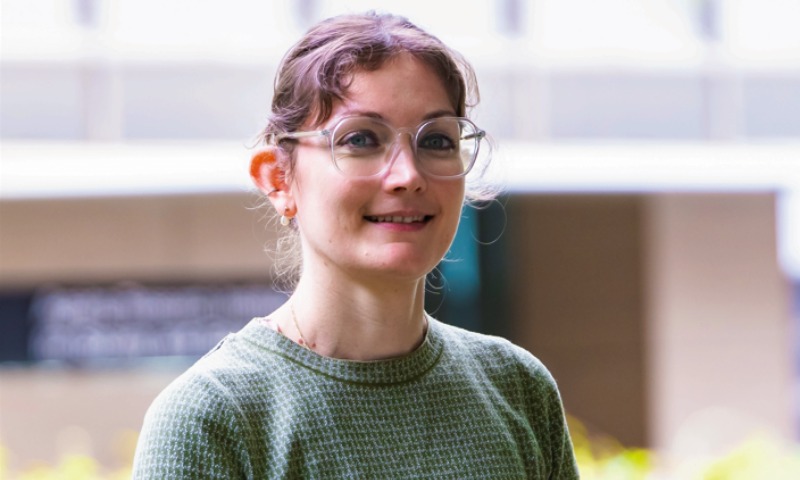
Dr Hortense Le Ferrand is Associate Professor at the schools of Mechanical and Aerospace Engineering and Materials Science and Engineering at Nanyang Technological University (NTU) in Singapore. She leads a research group on sustainable manufacturing for high-performance materials using principles from biomimicry and microstructural designs. She graduated from ESPCI Paris, France and ETH Zurich, Switzerland. In 2020, Hortense received the National Research Foundation Fellowship (NRFF) from Singapore. She was MIT innovator under 35, Nature awardee, inspiring women in science and Nanyang awardee in 2023, top 50 Asia Women Tech Leaders and Singapore 100 Women in Tech in 2025.
Recently, in an exclusive interview with Higher Education Digest, Hortense shared insights into her passion for developing high-performance materials, her approach to sustainable manufacturing, and her love for leading a research group. In her new book, “Reflections from the Tenure Track: Insights and Advice for Early-Career Academics in STEM”, she offers guidance on navigating the tenure process and making informed career decisions. Hortense finds joy in mentoring students and shaping the next generation of engineers and believes that creativity and experimentation are essential for innovation. The following excerpts are taken from the interview.
Hi Hortense. As a pioneer in sustainable manufacturing, what drives your passion for developing high-performance materials?
Our high-performance materials are essentially metal-based, but they pose a number of challenges. The most important challenge I see is the need to mine those metals which is often causing a lot of pollution, socio-economic issues, and now we see also a depletion of those resources. I hope to find ways to obtain materials with similarly high performance, or even better performance, but made in a simpler way, using more abundant resources and hopefully at lower energy consumption. This is where the bioinspired approach comes in. Bioinspiration is a design approach which consists in looking into nature to find mechanisms and models and transposing those mechanisms and models to our engineering needs. Nature excels at fabricating amazing materials only using water, carbon, nitrogen, oxygen, etc. and nature does all this at room temperature and ambient pressure.
What do you love the most about your current role?
I enjoy leading a group of students and researchers at a top research university. It is really a privilege. What I love the most is to have the independence to lead the research towards directions I find the most promising, and to see my students and researchers coming with even better ideas. In academia we enjoy a lot of flexibility which allow us to fully develop our areas of interests. It is very rewarding to see students developing into independent researchers and leaders themselves.
The world is shifting towards sustainable practices – What emerging trends do you believe will shape the future of manufacturing?
Industrial manufacturing tends to be resistant to change. It is hard to entirely change a production line that has been optimized for the last 20 years. However, the materials to use in these production lines can be more easily changed. What I believe for the future of manufacturing is a stronger focus on remanufacturing, recycling, and waste reduction along the production lines.
As technology advances, what skills do you think will be essential for the next generation of engineers and scientists?
While technology advances quickly, as we are witnessing with Artificial Intelligence, I believe that the next generation of engineers and scientists should more than ever be able to develop a holistic way of thinking. By this I mean for them to see “the big picture” and to remain consistent and focused, rather than being pulled in different directions by emerging trends.
Congratulations on your new book “Reflections from the Tenure Track: Insights and Advice for Early-Career Academics in STEM”. What inspired you to write this book, and what message do you hope your book conveys to women and other underrepresented groups in STEM, and how can it help shape the future of academic careers?
Thank you for mentioning my new book. My main motivation for writing the book was simply that I wished I had read something like this when I was only a student. Before becoming a professor, I found a number of online blogs, interviews, and journal articles that explained a little bit what it is to be a professor in tenure-track at a research university and what they really do, but I did not find a more comprehensive overview of the job in one single manuscript. In the book, I reference those resources I have previously read, many of which were written by women and have been a source of inspiration to me. I hope that the insights I share will help future professors better prepare for their academic careers. In particular, women and other underrepresented groups in STEM may not have access to informal advice and guidance. Hence, I hope this book can contribute to address that gap.
What insights do you offer on navigating the tenure process, and how can academics make informed decisions about their career paths?
As a student or early career researcher, we tend to think that research is the most important, but to be able to navigate the tenure process, one needs to not only conduct excellent research, but also manage the budget, hire the best people, supervise and mentor students, write reports, contribute to organizing meetings and symposia, network, teach, etc. Having a better understanding of the expectations, academics can identify their strengths and weaknesses, identify learning opportunities and which area they should focus more.
As an associate professor at NTU, what do you enjoy most about mentoring students and shaping the next generation of engineers?
What I enjoy most about mentoring students is when I offer a suggestion, they try it, and then come back with an even better idea. This is the moment when a student becomes the leader of their own research: they bring new ideas, develop them further, and push the work beyond what I had initially anticipated. Ideally, every PhD student reaches this stage at some point in their studies. I also value when students begin collaborating with one another and proposing creative, innovative projects.
You’re known for your innovative approach to research – What’s your favorite book or resource that inspires your creativity?
Thank you for qualifying my approach to research innovative. I think creativity comes from thinking “outside the box”. There can be several factors that support this. For example, my background in chemistry and materials science, combined with a strong interest in biology-related fields, allows me to approach topics such as manufacturing or mechanical engineering from a different perspective. I am also naturally drawn to the arts and enjoy visiting museums, reading essays and philosophy, which might further nurture my creativity.
What are some of your passions outside of work? What do you like to do in your time off?
I am quite active outside of work. I enjoy reading, traveling, group exercise classes, hanging out with friends, visiting museums, … but my stronger passion would be doing pottery. I have been doing pottery (or ceramics) for a very long time as a hobby, and especially now that I am not doing experiments in the laboratory anymore, I feel pottery is really the time of the week where I am experimenting and fully expressing my creativity.
What is your biggest goal? Where do you see yourself in 5 years from now?
My biggest goal is to see some of the developments from my research group being translated into real products. This is a well-known gap (the Valley of Death), between laboratory research and real applications. But I also have seen translation successes in academia, through spin-offs or industry collaborations, hence I am confident that it is achievable. In 5 years from now, I hope to progress within the academic ranks and take on greater leadership roles, particularly in research and faculty development.