



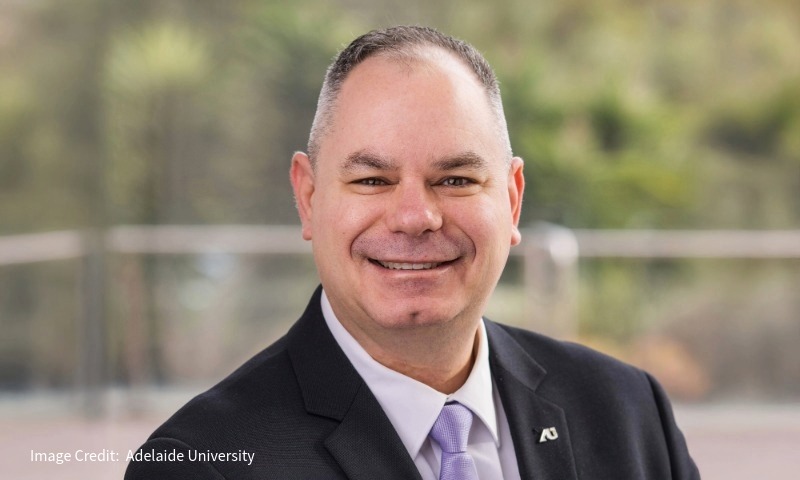
Professor Michael Goodsite is Pro Vice-Chancellor, Research Services and Infrastructure at Adelaide University and a Professor of Civil and Environmental Engineering. He works across research strategy, enabling services and infrastructure to support excellent, ethical and impactful research across the research value chain and is a member of the University’s Research and Innovation Executive Leadership Team. He serves on national boards and was recognised as one of five recipients of South Australia’s 2025 Positive Role Model Awards for ‘Educating and Researching for Impact’. Michael has held senior academic and executive roles in Australia, USA and Denmark, and is a Chartered Professional Engineer and Engineering Executive. Recently, he has been recognised as one of the top 50 Voices in Higher Education 2026.
In an exclusive interview with Higher Education Digest, Professor Goodsite shared what first drew him into research, what he thinks will define the next phase of research infrastructure, and the practical habits that help early-career researchers build sustainable, high-impact careers. The following excerpts are taken from the interview.
What first sparked your interest in research and academia?
It started with curiosity. I wanted to understand how ideas become evidence, and how evidence becomes practice. In engineering, that pathway can be very direct. Ask the right question and you can improve safety, strengthen resilience, reduce pollution, and make systems work better for people and nature.
Over time, I became equally interested in what sits behind great research. Why do some teams thrive? Why do some institutions consistently translate discovery into outcomes that matter? For me, that is the research ecosystem question. Culture, capability, infrastructure, and partnerships all contribute to shaping whether brilliant individuals can do their best work together.
My own path began in civil engineering, then postgraduate study in environmental engineering, then climate and environment, and later an MBA in global management. That mix took me into programmes where science, policy and real-world systems meet. In that kind of work, collaboration is essential if you want impact. I have also held academic leadership and research management roles in Denmark, the USA and Australia, which gave me an on-the-ground view of what strong ecosystems look like.
What has kept me in higher education is the combination of discovery and service. You contribute to knowledge, but you also help build conditions where students, early-career researchers and professional colleagues can do excellent work and grow into their potential.
What do you enjoy most about your current role?
I enjoy seeing the “invisible architecture” of research support show up in tangible ways. A well-designed service, a clearer process, or the right piece of infrastructure can quietly remove friction. Suddenly a team can move faster, work more safely, and make better decisions with more confidence.
The other thing I value is the span of the work. I get to work across the full research lifecycle, from the first grant idea through to the impact story. Sometimes that is creating a secure data environment so a collaboration can proceed responsibly. Sometimes it is simplifying a process, so researchers spend more time on discovery. Sometimes it is bringing partners in early, so translation is built in from the start.
It is energising because it is consequential. When capability, infrastructure, culture, and relevance align, researchers can be ambitious, ethical, and impactful. Professional staff are a vital part of that story too because research is a team enterprise.
Five years from now, what will define research infrastructure?
More networked, more digital and more sustainability focused. Research questions are becoming increasingly data-rich, interdisciplinary, and time-sensitive. As more disciplines adopt advanced analytics and AI-enabled workflows, secure and scalable compute and data environments will be as fundamental as laboratories and instrumentation.
We are also moving towards collaboration at scale, with more shared platforms and multi-institution consortia. That raises the importance of interoperability. Researchers need systems that support responsible data sharing and method reuse, while meeting expectations around integrity, privacy, and security.
Resilience will matter more too. Cyber security is no longer a specialist concern. It is core to continuity, reputation, and trust. And recent disruptions have shown how vulnerable research can be to supply chain constraints for critical assets, from specialised reagents to high-end instrumentation.
Sustainability is shifting from aspiration to operational reality. Energy intensity, lifecycle costs, and responsible procurement will increasingly shape investment decisions. Institutions that get this right will reduce environmental impact, improve reliability, and strengthen their social licence to operate.
Where is the biggest opportunity for researchers to drive positive change?
It is working across boundaries. The challenges that matter most rarely sit neatly within one discipline or one institution.
Researchers drive positive change when they co-design questions with communities, industry, and government, and when evidence is translated into decisions that improve lives. For me, the strongest combination is excellence and purposeful collaboration. That means rigorous methods, clear ethics and strong integrity, paired with respectful, two-way engagement.
The researchers who will thrive are impact literate. They can do discovery, but they can also communicate clearly, support implementation, evaluate outcomes, and use emerging tools such as AI responsibly.
What has influenced your thinking most?
A few frameworks have been particularly helpful.
Thomas Kuhn’s ‘The Structure of Scientific Revolutions’ is a reminder that progress is not always linear. Paradigm shifts often come from reframing assumptions rather than refining the same model.
Donald Stokes’ ‘Pasteur’s Quadrant: Basic Science and Technological Innovation’ has also shaped how I think about strategy. It validates use-inspired basic research. You can pursue fundamental questions while staying attentive to real-world needs.
I also return regularly to strategic reviews and roadmaps on national research infrastructure, research integrity, and open science. They connect high-level ambition to practical choices about investment, governance, and capability.
Mentoring early-career researchers: what actually helps?
I try to keep it practical and empowering.
- Clarify identity and direction. Help people articulate what they do, why it matters, and what a realistic plan looks like across publications, funding, collaborations, and time.
- Mentor and sponsor. Mentoring matters, but so does sponsorship. Create opportunities for early-career researchers to lead, present, and be visible in decision-making forums.
- Build capability as part of the job. Leadership, communication, ethics, project management, and responsible engagement are not optional extras. They are part of doing excellent research well.
Excellence and relevance are foundational. Relevance is often related directly to impact, but purposeful research tends to show up across the entire pathway, from discovery through to application.
What is your favourite quote?
“Chance favours the prepared mind”, often attributed to Louis Pasteur. Breakthroughs can look like luck, but they usually come to people and organisations that have built the capability to recognise what matters and act on it.
What are some of your passions outside of work? What do you like to do in your time off?
Outside work, family and close friendships keep me grounded. I try to stay active and get outdoors whenever I can. I also enjoy reading beyond my immediate professional interests, especially history, public policy, and biographies. If I get a quiet hour, you will often find me with music on and a book in hand, or in the water for a swim, or out SCUBA diving.
What advice would you give to early-career academics or professionals aspiring to leadership roles in higher education?
I have five pieces of advice.
- Know your purpose and values. They keep you steady under pressure.
- Learn how universities work. Strategy, budgets, governance, risk, and people leadership turn good intentions into outcomes.
- Be reliable and generous. Do excellent work, communicate clearly, and help others succeed.
- Own your development. Seek mentors and sponsors and take stretch opportunities that build breadth.
- Stay connected to the communities you serve. Leadership is a privilege. Keep listening, keep learning, and be a great team-mate every day.