



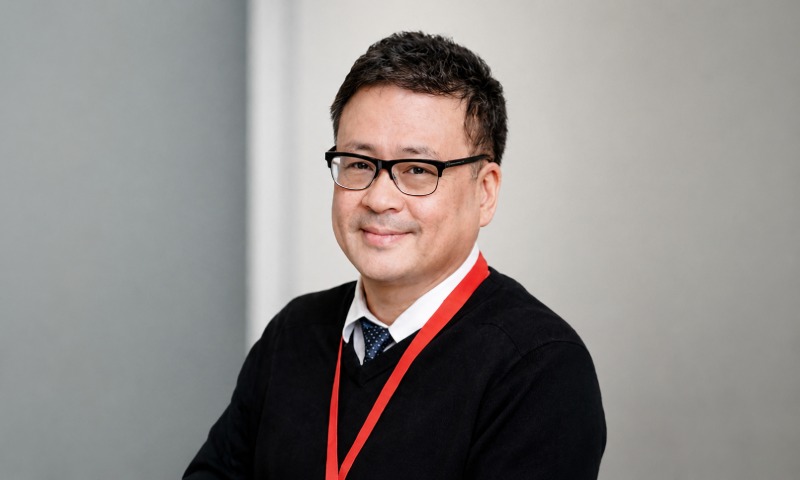
Professor Tony Jan is an academic executive in artificial intelligence and digital engineering with over 25 years of leadership experience across the University of Technology Sydney, Melbourne Institute of Technology, and Torrens University Australia. He has led large-scale technology and AI portfolios, connecting research excellence, curriculum innovation, and industry engagement in pursuit of institutional growth and academic excellence. Professor Jan has received multiple awards, including the SEI Global Academic Excellence Award (2024) and Torrens University Leadership Award (2022), and is a Fellow of Engineers Australia.
Recently, in an exclusive interview with Higher Education Digest, Tony shared insights into how his childhood fascination with AI and his 25+ year academic journey leading technology and AI portfolios across multiple universities shaped his mission to build scalable academic ecosystems. He spoke about the shift from AI as imagination to an AI-augmented force in classrooms, research, and university leadership, stressing that by 2030 universities must move beyond knowledge recall to cultivating debate, expert judgement, and AI-enabled human excellence. Looking ahead, Tony’s focus is on transforming higher education for the AI era by integrating research, teaching, employability, and industry engagement to prepare graduates and expand access, while urging the next generation of leaders to stay curious and translate new knowledge into lasting impact. The following excerpts are taken from the interview.
Hi Tony. You have 25+ years of leadership experience across multiple universities and academic institutions. What first sparked your passion for artificial intelligence and digital engineering in higher education?
As a great fan of 2001: A Space Odyssey and Isaac Asimov’s The Last Question since childhood, I actually believed conversational AI already existed when I was growing up in the 1980s. It was therefore a bit of a let-down to realise in the 1990s that these AIs did not really exist, except perhaps in a few specialised research laboratories.
It was a long wait to see AI gradually come to life. By the late 1990s and early 2000s, I was excited that there were finally opportunities to contribute, in my own small way, to this fascinating transition of AI from imagination into reality.
Since then, having witnessed multiple waves of technological disruption over 25 years through mobile technologies, the Internet, social media, AI, and now conversational AI, the journey has been both fascinating and rewarding. What continues to inspire me is the pursuit of new knowledge through research, the translation of that knowledge to teaching for younger generations to benefit, and connecting emerging AI and digital technologies to help graduates succeed in their careers—often going far beyond anything I could have imagined for myself.
You’re passionate about building scalable, high-impact academic ecosystems. What part of that mission energizes you most in your current role?
Higher education is uniquely positioned to explore new knowledge through research, translate those discoveries for the next generation of professionals through teaching, and then support their growth throughout their careers through a well-developed academic ecosystem.
Universities pursue research and teaching excellence, but they also need to scale and remain sustainable in order to continue creating impact.
Across multiple institutions, I have helped build such ecosystems, contributing to substantial and sustained growth of an additional 2,000–4,000 student enrolments while maintaining high academic quality and above-world-standard research performance. What energises me most is seeing research, education, graduate success, and institutional growth reinforcing one another to create lasting impact for students, universities, and society. I am proud to be part of that journey.
AI is moving from research labs into every industry and classroom. What’s the biggest shift you expect in how universities teach digital engineering by 2030?
In the new era of AI, knowledge is becoming readily available in many different forms. As a result, expertise based purely on knowledge itself may not thrive as well as it once did. Rather, the ability to debate, challenge, compare, and rationalise among different options and viewpoints, including those offered by AI, will become an increasingly important capability.
As a result, learning and assessment may gradually shift towards more open discussion and debate amongst competent human experts who are also able to use AI effectively. In many ways, the value may no longer lie in simply knowing the answer, but in understanding why one answer may be better than another.
AI is reshaping how we teach, research, and manage universities. As an academic executive, how do you see the role of university leaders changing in the next 5 years?
AI, particularly in its descriptive and predictive forms, has already been widely adopted across universities. Examples include identifying students at risk, supporting student success initiatives, and analysing program performance to inform decision-making.
The next phase is being driven by generative AI, which is increasingly becoming a capable collaborator and adviser to human professionals. Drawing on experience leading large technology and AI portfolios, I believe university leaders will need to seamlessly integrate established AI capabilities that support operational excellence with emerging generative AI technologies that can assist academics, researchers, and professional staff in their daily work.
Ultimately, the challenge is not simply adopting more AI, but using it thoughtfully to improve decision-making, reduce administrative burden, and allow staff to focus more on teaching, research, innovation, and student success – more human work.
Staff and faculty worry AI will replace parts of teaching and research. What message do you think leaders owe their academic teams about AI and the future of work?
The AI development is current and live, therefore it is difficult to predict its future, but the general consensus is that AI is not likely to replace human expertise but boost human capabilities beyond the current limits.
Having experienced the transition across multiple universities, I have seen how online technology expanded academic presence beyond the traditional classroom or lecture hall, which was often limited to accommodating 20–100 students in physical attendance. Online education extended learning across campuses, regions, and sometimes countries where permitted by governance. AI technology may similarly reduce unnecessary burdens on academics while amplifying their skills and knowledge to be transmitted to a much larger audience, perhaps beyond what we can currently imagine.
A university is considered large if it hosts 100,000 students, but perhaps a future mega-university may educate 500,000 students using advanced technologies that amplify human capabilities. Does this also imply lower education costs and greater access? The future is uncertain but it remains a very exciting and interesting space to continue monitoring.
You’ve built academic ecosystems across disciplines. Which book, paper, or thinker has most influenced your approach to education and innovation?
I was largely inspired by the late Professor Lotfi Zadeh, who dedicated his life to fuzzy logic and human-like computing. Whilst my own research is not in fuzzy logic, many of his early papers imagining future intelligent machines were fascinating and allowed a young scholar to dream about what might one day be possible.
Later in my career, many seminars, papers, and discussions inspired me to continue exploring probabilistic reasoning, and more recently federated learning in support of physics-informed AI, leading to research and industry collaborations with organisations such as NVIDIA and other major technology partners.
Looking back, what influenced me most was not any single technology, but the willingness of researchers such as Professor Zadeh to think beyond current limitations and imagine what future generations might build, and perhaps be part of that journey through research and teaching. I believe education and innovation often begin with that same willingness to explore possibilities that do not yet exist, driven by curiosity and a lifelong hunger for learning.
AI and digital engineering are intellectually demanding fields. What’s your favorite way to switch off and recharge outside of work?
My off time usually involves playing sports with my kids. In addition, I always find it fascinating to watch TV or YouTube series about the cosmos. The vast expanse of our observable Universe and its unknown limits, if there are any, always brings the realisation of how insignificant we are on this tiny dot in empty space.
Whilst acknowledging that and finding comfort in it, it also reminds me how unique humans are and how remarkable our education systems are, even among the living creatures on Earth. It brings relaxation and happiness to know that we are part of such highly intelligent beings, perhaps one of quite unique beings in this vast universe.
So besides martial arts and basketball games, learning about the cosmos itself helps me switch off, recharge, and perhaps even provides a form of meditation.
What is your biggest goal? Where do you see yourself in 5 years from now?
My biggest goal is to continue contributing to the transformation of higher education in the AI era. We are living through one of the most significant technological shifts in modern history, and universities have an important responsibility to prepare graduates, create new knowledge, and help society adapt to these changes.
Over the next five years, I hope to continue building and scaling strong academic ecosystems that integrate research, education, employability, and industry engagement. Whether through leadership, research, or institutional development, I would like to contribute on a larger scale and help shape how universities respond to the opportunities and challenges presented by AI.
What advice would you give to the next generation of leaders in tech education?
My advice to the next generation of leaders in technology education is to remain curious and maintain a lifelong hunger for new knowledge, as part of our academic obligation as well as personal pursuits. Be passionate about translating new research knowledge into teaching (not only for classes but for society at large), integrating employability into curriculum, and connecting research, teaching, and industry engagement to build sustainable educational ecosystems that support future generations of leaders. We are living through a remarkable period of technological change, and there has perhaps never been a more exciting time to learn, innovate, and contribute.