



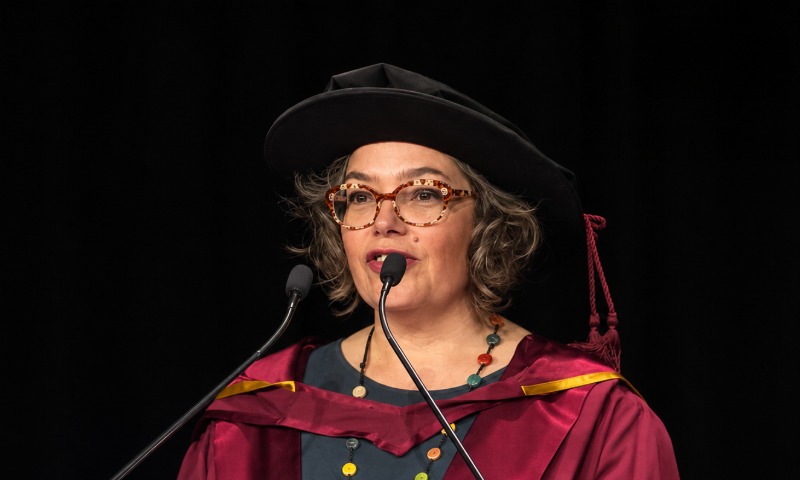
Professor Agnes Bosanquet is Dean of Billy Blue College of Design at Torrens University, Australia. A higher education leader, educator and researcher, she has an interdisciplinary background spanning media and cultural studies, education and the creative industries. As Dean, she leads design and creative technology disciplines with a strong emphasis on industry engagement, interdisciplinary collaboration, and real-world impact. Her academic work focuses on learning and teaching in higher education, with particular interests in academic development, professional identity, and the evolving role of creative disciplines within contemporary universities. She has published on academic practice, early career development, and curriculum and pedagogy, contributing to international conversations on the future of higher education.
Recently, in an exclusive interview with Higher Education Digest, Agnes shared insights into how her non-linear pathway from media and cultural studies teaching to leading design education programs shaped her belief that teaching is scholarly, relational and reflective. She views AI as shifting educators from knowledge delivery to enabling students to demonstrate learning with and without AI, making experiential learning, connection and imagination more critical than ever. She advises aspiring academics to ask meaningful questions and build communities of like-minded peers. The following excerpts are taken from the interview.
Hi Agnes. Your career spans teaching, research, and senior academic leadership. What first drew you to the field of learning and teaching in higher education?
My pathway into learning and teaching in higher education wasn’t linear. I sometimes describe it as a game of snakes and ladders! It was shaped by changing disciplines, different roles, and career interruptions that have made me aware of the unevenness of educational and academic journeys for many people.
When I first started teaching in media and cultural studies, I was still a student myself. I remember nervously standing in front of my first class and wanting to teach well, but I didn’t yet understand pedagogy or learning. I sought support from the university’s learning and teaching centre and a passion for academic development was born. I was inspired to undertake a Masters in higher education, which helped me find a language for what I had been doing intuitively. I came to see teaching as scholarly, relational and reflective, and I approach leadership in the same way.
You’re passionate about strengthening teaching quality and supporting staff. What part of that mission motivates you most each day?
Connecting with colleagues motivates me every day. As Dean, my role is to create the conditions where teaching, learning and research can thrive. This is a focus of strategic work across a whole institution, but it also happens through ordinary moments. In the coming weeks, I am looking forward to our Faculty Showcase, where academics present teaching, research and design work in progress; ‘Dean’s office hours’ which are a drop-in Q&A sessions; Design Pedagogy reading group, which has been reading collaboratively for almost two years; and mentoring sessions. I enjoy how these conversations unfold without a formal agenda. What motivates me most is paying attention to whether people feel supported, whether they have time to think, and whether uncertainty can be shared rather than hidden. That relational, ongoing work is what makes the role meaningful.
AI tools are now in every classroom and staff workflow. As an academic leader, how do you see the role of educators changing over the next 5 years?
For a long time, educators have been making sense of knowledge with students, rather than delivering it. This reflects Vygotsky’s social constructivism. With AI embedded in everyday practice, the educator’s role shifts further toward enabling students to demonstrate their learning with and without AI.
This requires close attention to how students think, experiment, and create, rather than assuming that access to information is enough for learning. Educators notice where students are, adapt in the moment, and create environments where students feel able to explore what they don’t yet understand. Liminality is part of the process. In many cases, students and teachers will be learning together.
Experiential learning is more important than ever! In my context of design education, it has long been understood that learning happens through making, critique, iteration, and practice. In many ways, learning to work with AI is similar.
Higher education is being reshaped by technology, policy, and student expectations. What’s the biggest shift you expect in teaching and learning by 2030?
Reading the tea leaves is tricky! I am optimistic that we will see an extended understanding of higher education across the life course, rather than something confined to a particular stage. If learning is ongoing, then relationships with educators—mentorship, dialogue, and communities of practice—become central. Institutions will increasingly need to sustain those relationships over time.
For some time, higher education has been shaped by efficiency, scale, and delivery. But what is becoming clearer in an AI-enabled environment is that learning depends on connection: between students and teachers, between peers, and between ideas and experience.
A shout out to some teachers doing this well: for example, Eddie Woo in making mathematics accessible, and Amanda White in accounting. They build engagement, confidence, and sustained connection to a discipline for the public.
Supporting academic staff development is core to your role. What’s one skill every educator should build for the next decade?
If I had to choose one skill for educators to cultivate, it would be imagination. It grows through practices such as conversing, reading, creating, and reflecting.
By imagination, I mean the ability to remember what it is like not to know something, to create spaces where learning can happen, to recognise different perspectives and meet students where they are.
Imagination is a relational capacity, grounded in empathy, attention and reflection. Our imaginative superpower is asking questions: What does learning offer, who is it for, and how might it support students not just now, but into the future?
In an uncertain contexts, imagination helps us resist defaulting to familiar or dominant patterns, and enables inclusive learning environments.
The Slow Academic suggests a different pace. What’s your favorite quote or mantra about learning, time, or purpose?
Academics often focus their research on something they find challenging, and that is true for my writing as a ‘slow academic’. The core idea is: take care how you spend your finite time and energy. The greatest gift I can give anyone, whether a member of my family, a friend, a colleague or a student, is my attention and care. I often come back to Mary Oliver’s line: “What is it you plan to do
with your one wild and precious life?” (I also return to her poem ‘I did think, let’s go about this slowly’).
I practice this through what I call my infinite daily goals. Every day I plan to do the same four things, whether a workday, weekend or holiday: join an interesting conversation, eat something good, spend time outdoors, and enjoy reading. I have maintained those daily goals for over five years!
A slow approach, for me, is about holding onto what matters most and is ongoing through times of pressure and urgency.
You write about academic life and co-lead a MOOC. Which book, article, or thinker has most influenced your approach to teaching?
If I had to choose one book, it would be Teaching to Transgress by bell hooks (1994), the purposefully lower case pen name of Gloria Jean Watkins. Its central idea—education as the practice of freedom—continues to shape how I think about teaching. hooks reflects on her own educational experiences in classrooms that opened up possibilities—spaces of joy and connection—and those that reinforced obedience and exclusion. As a university student, she became aware of “the kind of teacher I did not want to become.” Her vision of classrooms as engaging, communal, and intellectually alive has stayed with me. That remains a powerful guiding question: what kinds of learning spaces are we creating?
What is your biggest goal? Where do you see yourself in 5 years from now?
I hope I am still practising my infinite daily goals!
I want to continue shaping environments where teaching, scholarship, leadership and creative practice can coexist. I’m motivated by work that involves complex problems, trusted relationships, and developing others’ capabilities. Looking ahead, my focus is on continuing to learn and to challenge myself, while contributing meaningfully to those around me.
Aspiring academics often feel pulled between research and teaching. What advice would you give someone trying to build an integrated career?
My career hasn’t always felt integrated in the moment, but looking back, teaching and research have consistently informed one another. It’s easier to make a career trajectory look intentional retrospectively; along the way, it can feel messy!
It can be helpful to think of teaching and research as ways of engaging with questions that matter to you. Many of my research ideas have emerged from teaching and conversations with colleagues. Collaboration has been central—whether in projects, partnerships, or initiatives like the Contemporary Approaches to University Teaching MOOC, which brings together the voices and experiences of educators across institutions and disciplines. (We are currently looking for a new home for the MOOC after it was impacted by the closure of Canvas Free for Teacher).
My advice to early career academics is to stay with questions that feel meaningful and actively seek out conversations and collaborations. Finding or building a community of like-minded peers—through writing groups, professional networks, special interest groups, or informal collaborations—can make a significant difference over time.